01
What is the Aurora Borealis?
The northern lights occur when solar wind particles collide with atmospheric gases trapped within Earth's magnetic field lines at speeds over a million km/h.
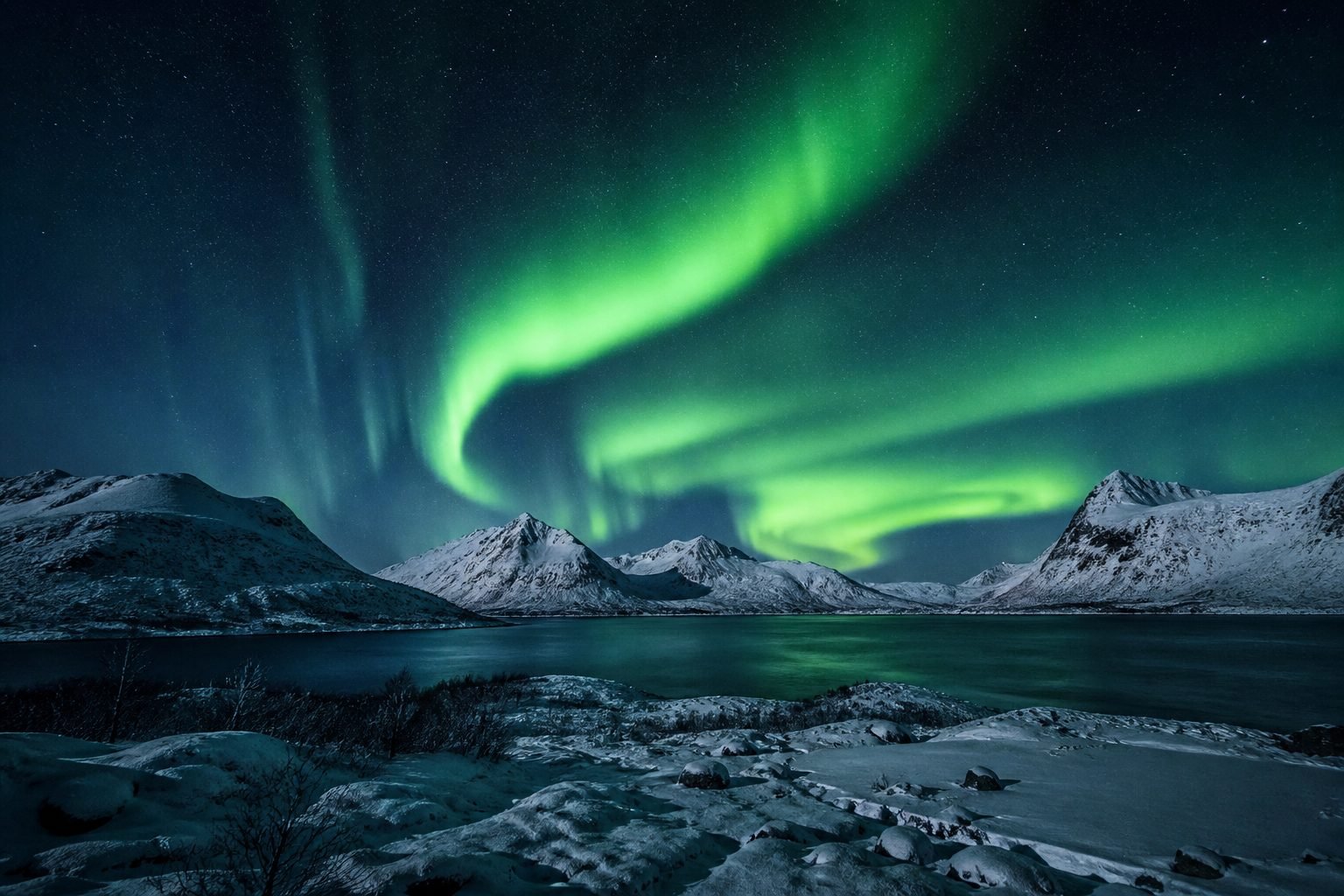
The northern lights (aurora borealis) shine brightest on clear, dark nights near the Arctic Circle — Iceland, Norway, Finland. Below: how they form, when to go, and how to photograph them.
The northern lights occur when solar wind particles collide with atmospheric gases trapped within Earth's magnetic field lines at speeds over a million km/h.
Colors correspond to gas altitude: excited oxygen atoms at 100–300 km create brilliant neon greens, while high-altitude nitrogen adds violet, pink, and deep crimson fringes.
Between September and March on clear, moonless nights above the Arctic Circle. Prime European hotspots include Tromsø, Abisko National Park, Finnish Lapland, and Iceland.
Lock down a sturdy tripod, set a wide fast lens (f/2.8 or lower), manual focus to infinity, ISO 1600–3200, and expose for 4 to 12 seconds.
Only during severe solar storm events (Kp 7+) with unobstructed clear northern horizons.
Displays range from ten-minute pulses to multi-hour waves rolling across the sky.
Yes, identical magnetic physics: known as aurora australis in the southern hemisphere.
Atomic oxygen at ~100 km altitude is the easiest gas to excite and emits light at human eye peak sensitivity.
Type any question on Focie Explains and get an instant interactive scrollytelling explain in one click.